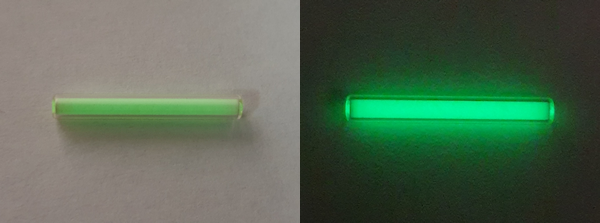
Here is a 24 day and 10 hour long accumulation from a glow in the dark Tritium tube, vial, thing. It's just like the ones used in fishing indicators, clocks, watches and military defile markers. Often called 'beta lights'. Total counts: 76,669,829 😄 The massive peak at ~11.8 keV is from Zn Kα X-rays emitted as the Tritium hits the zinc sulphide phosphor and the smaller (~85 keV) peak is most likely from X-ray fluorescence from materials near the detector, or could be backscatter from the detector housing. My spectrum is ever so slightly out by 2-3 keV as the peak is shown on the chart at
-
-
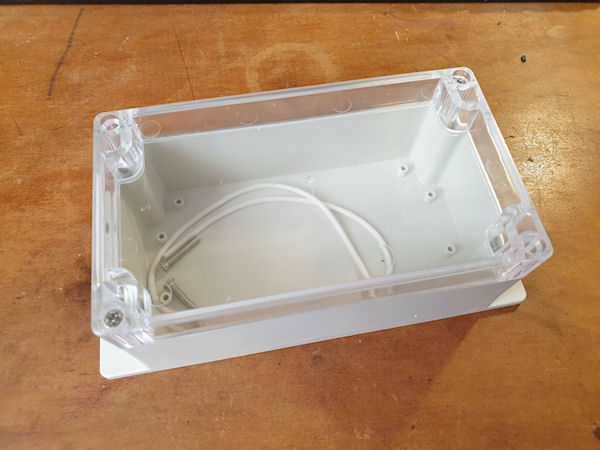
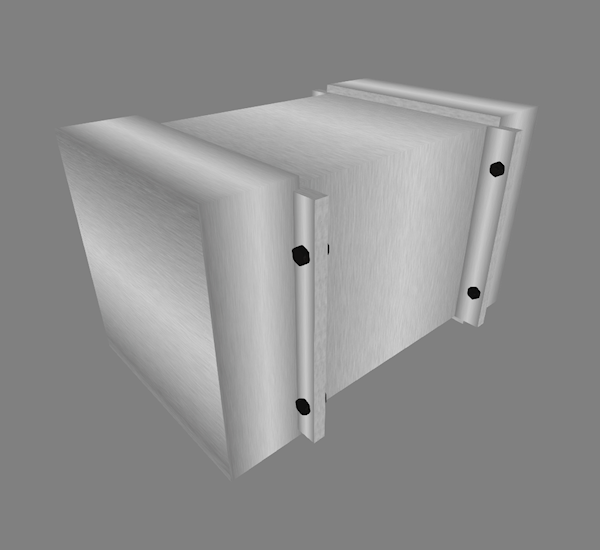
I want to build a radiation shielded chamber for Gamma spectroscopy using my Radiacode 103. After batting some ideas about on another thread this is what I have so far: Outer case is 6mm steel (mild steel) - This could be a square tube section, or made from sheet. Inner case is the same as the outer and has 60mm x 60mm to 75mm x 75mm (thereabouts) space in the center for the Radiacode and source. Internal length of the chamber will be ~200mm. Space between the inner case and outer case will be filled with lead, ~25mm thick. Tabs/flange on both caps and outer case to put bolts through to fix
-
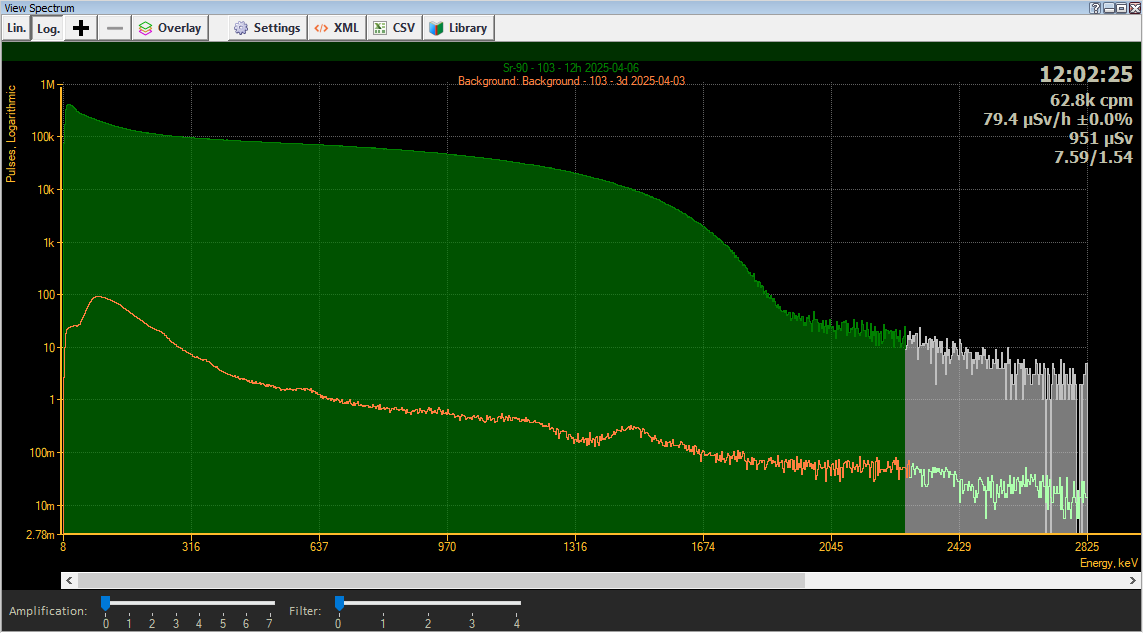
Here is a 12 hour spectrum accumulated on the Radiacode 103 of a spicy Sr-90 (Strontium-90) check source (~100-200 Bq) from a DP-5 Geiger counter. Both Lin and Log are shown. Archived from radmon.org - originally posted 06/04/2025
-
Experiment - Capturing Radon progeny from Uraninite (Uranium ore) This should be quite interesting to anyone that owns or is thinking of owning Uraninite (Uranium ore) sources, and anyone with a keen interest in Radon. TL;DR - Skip to the last part for safety concerns with U-238 sources and also Thorium gas mantles, Thorium dioxide. This was a fairly well controlled experiment that was carried out at home, and using ChatGPT as my lab sidekick. The idea was to capture Radon progeny from 4.46g of Uraninite (Uranium ore) and prove the decay products. Uraninite emits Radon gas and this decays
-
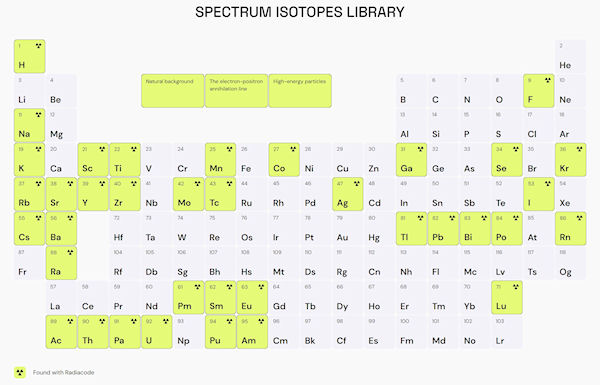
The Radiacode website has a great isotope spectrum library: https://www.radiacode.com/spectrum-isotopes-library All of the spectrums are from the mobile app for the Radiacode so don't have a massive amount of detail, but there is some great information for each isotope, such as half life, emission lines and a decent description of where they may be detected. Archived from radmon.org - originally posted 12/12/2024