Gamma Scout (Alert) - The Marmite Counter?
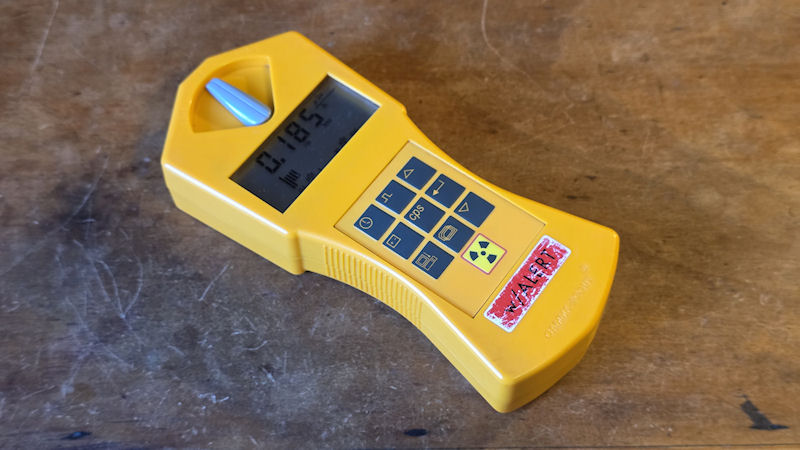
The Gamma Scout Alert. Detects α β and γ using a LND 712 Geiger Müller tube and employs a self contained long life battery and extremely low power consumption.
The Gamma Scout is arguably one of the more divisive Geiger counters out there. Some people love it, some people hate it, and personally, I have something of a love/hate relationship with it. It really ought to be nicknamed ‘The Marmite Counter’. Project 326 made a rather interesting video on the Gamma Scout, here. I don't think Project 326 likes the Gamma Scout much. I also think that Gamma Scout (the company) doesn't like the fact that Project 326 dislikes the Gamma Scout so much. It seems a lot of people have an opinion on the Gamma Scout these days, whether they own one or not. But personally, I think you have to own one, or at least use one for a length of time to actually weigh up the good points vs the bad, and then there is the real ugly. It's not all bad though. This counter does have one really quite amazing good point, which I will come to in a bit, so please read the full article. And by ugly I mean the UI/UX (user interface / user experience). It is horrible. It is the most complicated, least intuitive counter I own and have used.
If you leave home with your Gamma Scout, take the manual with you! You will probably need it!
The Gamma Scout is the brainchild of Dr Georg Dieter Mirow. On a visit to Chernobyl during the 1986 disaster he wanted an affordable radiation instrument that an ordinary person could own and use independently rather than relying entirely upon official published measurements. Long story short - Tilmann Krueger and Dr Georg Dieter Mirow both invented the extremely low power consumption HV PSU we see in the Gamma Scout today, and the Gamma Scout was born from that. Their US patent, US 6,194,882, was eventually granted in 2001. Their idea was to have an always on, extremely low power radiation detector that ran for years, that the general public could use and trust the readings. They did just that.
- 1986: Chernobyl gives Mirow the idea.
- 1995: Gamma-Scout says development/production effectively begins around this time.
- 1997: The key engineering patents are filed; Mirow also registers Gamma-Scout as a trademark. The WIPO record shows the international mark registered on 6 November 1997, owned personally by Dr Georg Dieter Mirow of Schriesheim.
- 1999: Contemporary German reporting later identifies this as the year commercial manufacture of the handheld Gamma-Scout began.
- 2002: Wired reviews it in the US for $297, already highlighting the ten-year battery, permanent operation and computer logging.
The Gamma Scout comes in four flavours, the standard, alert, rechargeable and online.
- Standard - Logs and displays, nothing else.
- Alert - Logs, displays, has ticker and alarm.
- Rechargeable - Logs, displays, has ticker, alarm and is rechargeable (full charge lasts approx. 2 months).
- Online - Logs, displays, has ticker, alarm and can be tethered to a computer by USB cable to view live readings. Also has graphical software.
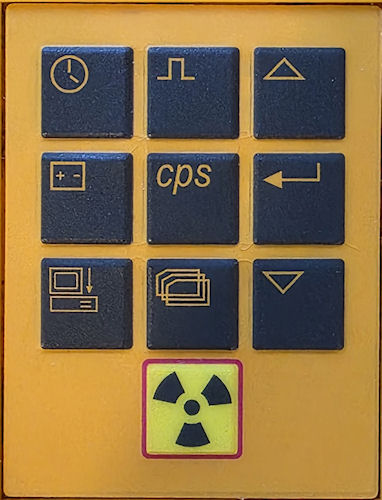
Can you make sense of this keypad?
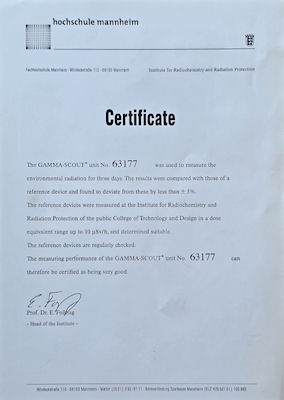
I bought my Gamma Scout Alert used on eBay for around £140 in December 2018. It came in quite used, but good condition, complete with the original box, manual, USB cable, software CD and a certificate - two actually, one in English and another in German. It worked right out of the box, as in it was already switched on, then I discovered this thing is always on. There is no on-off switch. It just runs all of the time. I have made a number of posts already on the Gamma Scout (listed at the bottom of this article) so I'll not spend too much time rewriting what I already have, though I will briefly run through the good and bad points, in my humble opinion.
First, the bad and the downright ugly: 🤮
- Its interface, the keypad, the hieroglyphic type symbols bear little meaning. Intuitivity becomes a negative with this counter. I have had this counter for eight years now and although I haven't used it much, I have run through all of the features and menus a couple of times. I remember nothing of them. As I am writing this, I thought I would test myself and see if I could get it to display CPS. I thought couldn't at first. Logic dictates I press the CPS button and it would display CPS, right? Noooo, not with this counter (actually it did). It just displayed a number, 0.000 then after a few seconds increased to 0.063, then to 0.156. There is no 'CPS' icon displayed on the LCD. We do see a 1 over an S icon in the top right, but why not have a 'CPS' icon? I do know how to see the battery voltage, but simply because I spent a load of time with that one function when modifying mine with the replaceable battery mod. I also know how to activate the clicker too, because everyone loves the clicks, so it's one of the first things to learn. Except this doesn't click, it bleeps. I much prefer a click to a bleep. A bleep doesn't seem radiation like, but a click does. Everything bleeps these days. Radiation clicks are almost immediately discernible as radiation, bleeps are discernible as some device that bleeps. I digress. Those are the only functions I can operate from memory, anything else I have to consult the manual - not good for ad-hoc field work, unless you are very experienced with the counter.
- The keypad and general construction of the counter leave little to be desired. The keypad is not nice. It is something akin to the 1979 Bigtrak toy's keypad that I had as a child, except I think the Bigtrak's keypad was probably better! My Gamma Scout has an air bubble trapped under it's keypad where the adhesive attaches it to the case. As a result pushing buttons can move this air bubble about and it makes terrible clicking and creaking noises from the adhesive sticking and coming away as the bubble moves around. If you look closely at the picture of the keypad above you can see small cracks starting to appear at the corners of the middle button. The case too doesn't feel nice in the hand. It creaks about and generally doesn't feel very tough.
- The α β γ selector is equally not nice and when I took mine apart I found the plastic selector had been wearing against the metal spring and there was some plastic dust inside the case. Applying a little silicone grease eased this and gave the selector a much better feeling detent.
- The battery is not easily user replaceable and their documentation states to return it to their factory for battery replacement.
Now, the good: 😄
- This counter contains a good tube - a LND 712. This tube is sensitive to α β and γ and the selector on the counter can be used to shield the end window of the tube from α or α & β. Essentially, you can detect α β γ, β γ, or just γ. Each Gamma Scout is also factory calibrated and undergoes a strict testing program before it leaves their factory, according to their documentation.
- It supports logging and the logs can be downloaded and read on a PC.
- The 'Ten Year Battery' (problem?) The battery is a single AA sized, 3.6 V Lithium Thionyl Chloride cell and it is soldered directly to the PCB. Any user with soldering skills would be able to replace the battery, however those without soldering skills would not. Gamma Scout state this battery can last up to ten years, and maybe so if all it detected was minimal background radiation and not a single button was ever pressed on it. It's a bold claim, and one I can't say I agree with. To get the full ten years battery life essentially means not using the counter. Well, not quite, that's a little harsh. To get full benefit from the stated battery life it would have to have very light use. Enabling the ticker destroys the battery life with up to 500x the power consumption for each bleep. The battery in my counter was dated September 2013 and I had to replace it in December 2021, so it did really well, but not quite the ten years, and is probably due to its light usage. It also had next to no use from myself since I bought it in December 2018. This also brings me on to....
- Power consumption. This is where this counter marvels against other counters. It is powered on all of the time. It is ready to use at a moment's notice and stays like that for years after purchase. The counter consumes a remarkably low current. The high voltage PSU is a fantastic design and uses a high voltage reservoir capacitor to feed the HV to the tube and when pulses are detected the power is drawn from the reservoir capacitor and not the PSU directly itself. The PSU also switches into a standby state when the reservoir capacitor is full. There is a voltage sensing loop from the reservoir back to the HV PSU and goes something along the lines of - charge reservoir - turn off - tube detects pulses, uses a little power - feedback loop tells PSU to turn on - PSU tops up reservoir and turns off again. And it can do this (at background counts), power the MCU and LCD at a mere 10 µA consumption. And that coupled with a quality long life battery means this counter does work for years from a single battery.
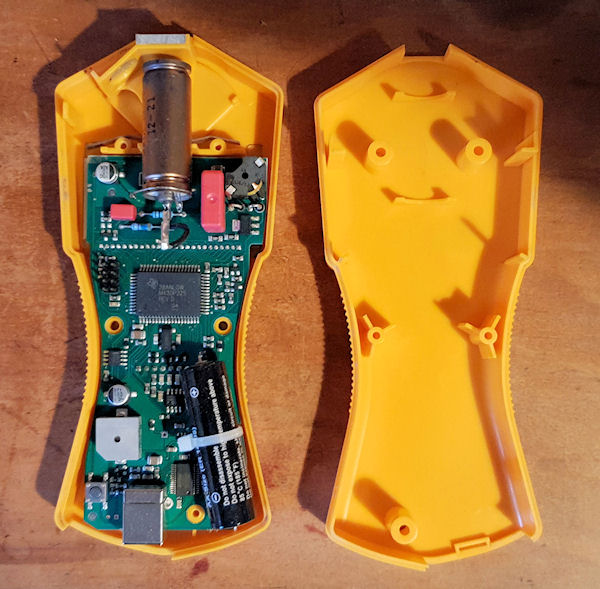
Specifications:
| Radiation Detector: | LND 712 end-window α β γ sensitive Geiger Muller tube. |
| Radiation Types | α from 4 MeV β from 0.2 MeV γ from 30 keV |
| Selection Shield (for point radiation) | α + β + γ without shield β + γ: aluminium foil, approx. 0.1 mm, fully blocks a radiation γ: Aluminium shield approx. 3 mm - fully blocks a radiation; blocks β radiation up to 2 MeV; less than 7% attenuation of γ based on Cs-137 |
| Power Consumption | Less than 10 microamperes under environmental radiation |
| Storage | 64 KB (approx. 32,000 data records - See table) |
| Weight | 165g (with my battery modification) |
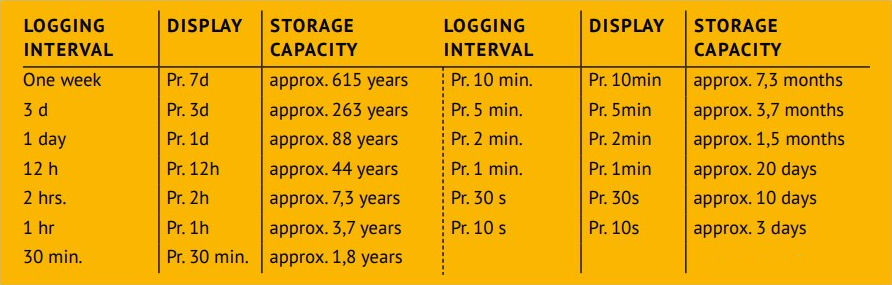
What I would change: 😁
If Gamma Scout (the company) came to me and said, "Hey Blinky, you are smart and know a bit about counters these days, how could we make the Gamma Scout better and more attractive?" To which I would reply:
Keep the super sonic power supply design and battery sources. Keep the always on and low power consumption (except for the rechargeable). Keep the ability to simply pick this up at a moment's notice and use it. Keep it's reliability and accuracy, all as they exist with the Gamma Scout now as they are the strengths of it's current form. But, make it more rugged, more user friendly, consolidate the current four flavours into two versions. One rechargeable and one with a user replaceable long life battery - both versions have the same features. The battery could be contained within a sealed, water tight tube enclosure with a nice machined stainless steel coin-slotted screw cap. Make the interface more intuitive. Scrap the hieroglyphics and opt for an up, down, enter menu system, and make the screen reflect what the user is actually looking at. Use some simple symbols and acronyms CPS, CPM, µSv/h. Keep the big basic display as is, but alter the symbolism around the chunky numbers to something understandable.
Put it in a decent glass reinforced plastic case so it would bounce if dropped. Add some basic sealing inside the case. I wouldn't be looking at being able to submerge it, but it should survive a drop in a puddle, or a fall in a river (and then quickly back out again). This wouldn't be difficult. The case can stay a clam shell form, with a small rubber seal running at the seam. The battery is already in it's own submergible section. The tube is a little more complex but a simple rubber grommet around the (LND 712) tube and the case sealing off the front of the tube from the rear would offer a nice level of water resistance so that if it was dropped in water, ingress would need time. The front of the tube would get wet, no doubt there. But a shake out and let it dry and it should survive very brief interactions with water. It could be used in light rain too.
And with two models, one rechargeable one long life, keep the features identical on both models. Use the same case for both so just one tooling cost. Use the same waterproof battery enclosure design on both. The long life gets a Lithium Thionyl Chloride cell and the rechargeable gets a user rechargeable cell of similar formfactor. Both models would have a waterproof USB C connector on them, for data transfer and charging the rechargeable. They both get live data on screen, both have alerts, both have tickers, and both can have a little additional unit, sold separately, that simply plugs onto the bottom of the counter and gives it WiFi and/or BLE (with it's own internal rechargeable LiPo cell) and relevant software/phone app that people can buy at their will.
And in a nutshell, that would be my Gamma Scout Mk II.
Final thoughts and opinion: 🤔
For me personally, it is just another counter that is a part of my collection. Would I have bought this brand new to add to my collection, no. I also wouldn't buy this counter these days to use as intended unless, and this is the only single reason I would buy this counter today, if I were to go on a journey where I had no access to any power for recharging or a supply of batteries and I needed a radiation detector. The chances of that happening with me these days is slim to none. These days it's not uncommon for people to take portable solar cells and power-banks on journeys with them, so the need for a counter whose only main purpose is to stay on and alive is very small. The Gamma Scout rechargeable I simply would not purchase today because the only saving grace for the Gamma Scout is it's always-on, and on for a long time feature, which you do not get with the Gamma Scout rechargeable. The Gamma Scout rechargeable will last for around 2 months on a charge, and requires USB charging. There are better alternatives at lower prices. I think having a Gamma Scout that took two AA batteries would be worth more to people than the rechargeable, but that's just my opinion.
If you don't need to detect alpha radiation, and can charge USB C devices then the Radiacode RC-103 blows the socks off the Gamma Scout. I can buy the Gamma Scout Alert and with shipping and UK taxes it comes in at £499.43 if I were to buy one today. I can purchase the Radiacode RC-103 for £333.00 all in. It's a no-brainer. The RC-103 has way more features, way more. They both have a theoretical max dose rate of 1,000 µSv/h. The Gamma Scout is much heavier at 165g (with replaceable battery mod - bear this in mind), whereas the RC-103 is 65.4g. The Gamma Scout is large compared to other counters of today, the RC-103 being around 1/3rd of the size of it. The RC-103 has a very easy, intuitive UI/UX, the Gamma Scout does not.
I think the radiation detector market has surpassed what the Gamma Scout can provide today, and maybe it is time for Gamma Scout to revise their models to fit in with what is available today. As it stands it is a good counter, and will easily surpass the cheap counters available at the usual outlets, but when you compare it on price to other detectors that are available today it struggles to keep up. I think a lot of people may purchase a Gamma Scout today based on nostalgia, and maybe seeing people using it in older pictures and videos.
For a further look at the Gamma Scout have a read of my posts here and here.
I have modified my Gamma Scout with a replaceable battery mod, and also modified it to connect up to a microcontroller such as the ESP8266, which can give a much better, finer and longer means of logging from it, with caveats.
Replaceable battery modification.
MCU logging modification - it works well with ESPGeiger.
Gamma Scout Manual