
- Posted on
- • Geiger Counters
ESPGeiger ESPGeiger ESPGeiger!
- Author
-
-
- User
- Mr Blinky
- Posts by this author
- Posts by this author
-

Why are you prattling about with coding your own ESP8266 or ESP32 to run a Geiger counter when you can simply run ESPGeiger! Yaaay! 😄
I actually mean that. Stop messing with code that will give you only what you want. Choose ESPGeiger and get all the beans! I'm joking, but now seriously, ESPGeiger is good. No, it's not just good, it is fantastic! Let me tell you why.
The first thing is as of the time of writing, ESPGeiger is currently under development, meaning as you read this, Steadramon may be bashing away at his keyboard making it better. Steadramon is the guy that wrote ESPGeiger and maintains it.
ESPGeiger is an open source Geiger counter firmware written by Steadramon. It started out a couple of years ago and had a huge amount of development to make a really good MCU firmware for many kits and commercial Geiger counters. With some very basic electronics knowledge you can buy an off the shelf cheap Geiger counter, attach some wires, flash the firmware (by web, I'll come to this later) and have your cheapo Chinesium counter submitting readings to a handful of very handy destinations. Then it went quiet a bit, but recently has come back full force and smashing boundaries. It's gone from child to adult, fast.
Now before I go into features I want to concentrate on usage cases first. For me, I want to submit my readings to radmon.org, that's a primary, also my own web server, again a primary. So I get a new counter, grab an ESP8266, and program it to do just that. And then when I see the other services and things, I don't quite know how to do those, and there is little info about them. I can pick up snippets of bits and try and wrangle them together and debug, debug, debug some more, and maybe get a loosely cobbled together version of something that works, if I am lucky. Time spent usually means I prosper one way or another. And that is what I did for a long time, until ESPGeiger.
ESPGeiger has it all. It is a Swiss army knife of Geiger counter MCU interfaces. Just load it up and configure. I see this as something special. There is nothing out there like it. Its feature rich and requires next to no electronics knowledge. All you need to know is how to power it, and get that pulse to it (or serial). Three wires, that's it. If you don't know your pulse pin from your voltage pin, you are going to be knackered, but if you can grasp some very basic electronics, you can turn your counter into a singing and dancing reporting mini background monitoring station. Really, simples.
So now we are happy with our three wires, plus, minus and pulse, as simple as red to red, black to black, blue to bits! 🤣
We have this connected now, so what does it do? Firstly it submits to radmon.org, ThingSpeak, Home Assistant, GMC map, the ESPGeiger network, and my server via webhook, and some more, in a tiny ESP8266! Oh it also has it's own web interface where all the config happens, and some live readings and history, and stuff, you know, stuff. This has it all, and more.
So lets configure radmon (create an account, create a station and start submitting), same with GMC map, ESPGeiger network is automatic, unless you disabled it. What else do we have? ThingSpeak. I never used that, I really can't comment, but going from the other integrations, I suspect fill in the details, sit back, profit.
There is also the webhook. I asked for this and got it. I actually got more than I asked for. I wrote AI wrote a PHP back end for the webhook. It catches the readings and stuffs them right into MariaDB. I can do what I want with them now, and I have done. I display all of the ESPG's on my site in the 'radiation monitoring' part.
Right, I had better get to the feature list, here: (copy pasta from the ESPGeiger docs page)
- Web Portal - internal web portal where you configure or mess up things.
- History page - Shows you some history, averaged counts every hour.
- GMC - Puts you on the GMC map.
- Home Assistant - Makes the data available on your desktop or other outputs, via Home Assistant <-- It works, very nicely.
- MQTT - Part of Home Assistant for me, if you run your own MQTT server, you can make the reading appear there.
- Neopixel - Honestly, an annoying and less informative part of the project, but maybe I am missing something?
- OLED - Yay screens! We all need screens and this does a nice job of displaying info on a small footprint. It supports various OLEDs too. 10/10
- Radmon.org - My fav, my home, my bed. If it doesn't submit to radmon.org, it's just broke to me.
- SDCard - Some flavours can record to SD Card. I'm currently playing about with that feature a bit more.
- Serial Output - Required in some cases. I have the serial out from a UDP receiver running into Radlog Pro, cos I die, hard.
- ThingSpeak - Don't use, honestly not really interested in, but it's an option for those that use it. It will work, cos Steadramon.
- UDP / OSC - This is nice, and very different! UDP TX transmits what the counter is doing, and the RX mirrors it, or combines the sum thereof many counters. Really quite interesting, and very useful, in certain circumstances. And I am certain circumstances.
- Webhook - Yes! This feeds my SQL database with every number the ESPGeiger cares to give up! This is essential for me. Provides live raw data to MySQL, I save it and can play back. As it happened.
- Integrations - You can query the thing, or call up some pages/switches and it will give you stuff. Ask it /json and you get data. It's poetic in it's nature.
- ESPGeiger Stations - And finally Steadramon's own system for keeping tabs on the ESPGeiger builds out there. Mainly for debugging/improving. It's also a nice site, fast and snappy, like ESPGeiger, and serves it's purpose right.
It's sporting more features than a Ferrari gearbox has teeth! Massively feature packed, and attention to detail spent on every one.
Those are the basics, but there is more! ESPGeiger comes in various builds, each being slightly different. You can choose between a pulse input or serial. You can add in an OLED. There are hardware specific builds (more on that in a bit). There is a build specific for logging to an SD card. A build to run as a UDP receiver, and some builds for testing too. All of these builds allow for complete customization for your setup. You want an OLED, you can, you want it to output on serial, like a NetIO GC10, you can. Want to whiz your data through the air and have a tethered serial connection, you can.
There are configurable alerts. I'm not sure this is fully implemented yet, but if not, I suspect it won't be long.
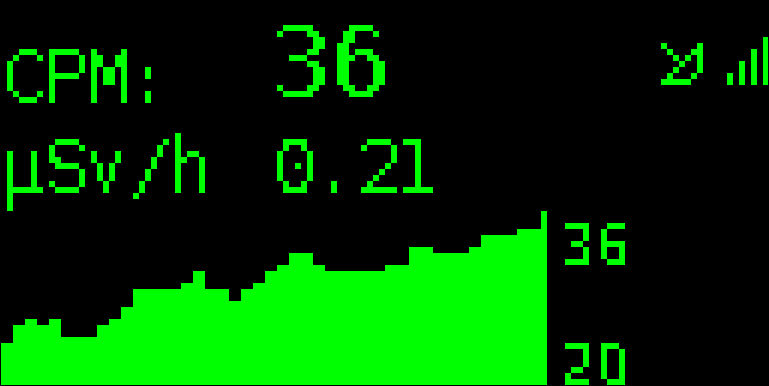 The OLED builds have a feature where you can get the screen up in your browser. You can actually install a build with OLED support, not connect the OLED and use the little web OLED screen. You don't have the /screen feature on builds without an OLED.
There are also HV (high voltage) builds that have a fully configurable (frequency and duty cycle) PWM output to run HV boost converters, such as many low cost Geiger counters have. The GK Radmon's, NetIO GC10's, CAJOE and many more have this HV boost type PSU, so ESPGeiger HV will happily run these, or even run your own design. If it needs a PWM input to make the HV, ESPGeiger can do this. I recently modified a GK Radmon to run ESPGeiger and now I set the tube voltage in the ESPGeiger interface. No more twiddling pots.
Most main builds of ESPGeiger can be installed via a web installer (confirmed to work in Chrome, Edge and Brave. Others may work, some may not - the browser needs to have serial/com port access). It is as easy as plugging in your ESP8266 into USB, fire up the installer page in a browser, select the build, choose an OLED, yes or no and hit the install button. Then once flashed, setup the WiFi and that is about it for installing the firmware. Then connect to your counter by pulse or serial, setup your services, go drink beer.
When has there ever been an Arduino sketch, or an ESP8266 firmware for running Geiger counters that has been so feature rich, and good, that someone can write all this about it. Never! This is something quite new, although it has been about for two years. It has really come together of late.
The UDP receiver build is very interesting and I use it for getting the CPM from an outdoor counter, through the air, down a USB cable and into the com port for RadLog Pro. UDP RX effectively mirrors one counter on your network. What the TX is doing, happens on the RX. You can have a pulse build somewhere, say outside in a sealed enclosure and run the RX as a mirror with an OLED on it, effectively giving you a remote display. I am going to play about with the RX some more in the future and maybe make some ESPGeiger Log's into a small recording remote display. UDP RX can also be setup to combine all of your locally broadcasting UDP TX's to display the sum thereof on one display. I haven't tried that yet, but soon!
Then we come on to some of the obscure elements of ESPGeiger, and the data it is capable of exposing. Various applications can interrogate ESPGeiger for it's current readings and then the application can use them. Some applications include Prometheus, an open source systems monitoring system, GeigerLog, InfluxDB via Telegraf, Node-RED, Grafana, and likely many more if the application is simply set to read the /json data from ESPGeiger directly. There are also tools for emulating pulse and serial counters, for testing purposes.
And there is more! Well, sort of. ESPGeiger was born (AFAIK) to run a counter, the ESPGeiger HW. I have my hands on a couple of early prototypes and they are pretty good. They are a basic counter hardware, not unsimilar to the GK Radmon or the NetIO GC10, in fact I can see parts where they have inspired Steadramon. The ESPG HW works very much the same, except for it's ESPGeiger firmware, which takes a cheap basic counter and gives it bells and whistles and all the bling. It seems development on the ESPG HW has slowed right down, but the firmware came off of the back of the ESPG HW and that has been getting all the attention. I hope Steadramon gets back to the hardware at some point because it really would be a shame to not see it come to market.
There is also the ESPGeiger Log. That did go to market, but didn't last out there that long. That wasn't a counter it was simply ESPGeiger on a board, with an OLED and SD card slot just ready to connect to a basic counter. Knowing Steadramon, the reasons for not pushing the hardware will be valid, and I suspect most likely it is the firmware that has simply just had the time and not the hardware. I'll keep my fingers crossed that one day he will release some hardware to go along with the exceptional firmware he has developed.
And with all that, I give Steadramon and his ESPGeiger, Mr Blinky's Bona Fide Brilliant award! Yaay! Steadramon has done a striling job with ESPGeiger, and should be very proud of it. It is fully fledged grown up firmware for ESP8266/ESP32.

Add Comment
This policy contains information about your privacy. By posting, you are declaring that you understand this policy:
- Your name, rating, website address, town, country, state and comment will be publicly displayed if entered.
- Aside from the data entered into these form fields, other stored data about your comment will include:
- Your IP address (not displayed)
- The time/date of your submission (displayed)
- Your email address will not be shared. It is collected for only two reasons:
- Administrative purposes, should a need to contact you arise.
- To inform you of new comments, should you subscribe to receive notifications.
- A cookie may be set on your computer. This is used to remember your inputs. It will expire by itself.
This policy is subject to change at any time and without notice.
These terms and conditions contain rules about posting comments. By submitting a comment, you agree with these rules:
- Although the administrator will attempt to moderate comments, not all comments can be moderated at all times.
- You acknowledge that all comments express the opinions of the original author and not those of the administrator.
- You will not post material which is knowingly false, obscene, hateful, threatening, harassing or invasive of privacy.
- The administrator has the right to edit, move or remove any comment for any reason and without notice.
Failure to comply with these rules may result in being banned from submitting further comments.
These terms and conditions are subject to change at any time and without notice.
Comments