
- Posted on
- • Geiger Counters
AEGTest Hound-3699 Radon Monitor - Pt.3 The Chamber (teardown)
- Author
-
-
- User
- Mr Blinky
- Posts by this author
- Posts by this author
-
The Chamber.
I wasn't actually going to look into the chamber more, but a radmon.org user was curious, and curiosity got the better of me, so I dug into it - and I'm glad I did! Quite interesting. A little, but not actually quite as I expected. (I have added the high resolution images of this post to the download in the first post of the AEGTest Hound-3699 series.)
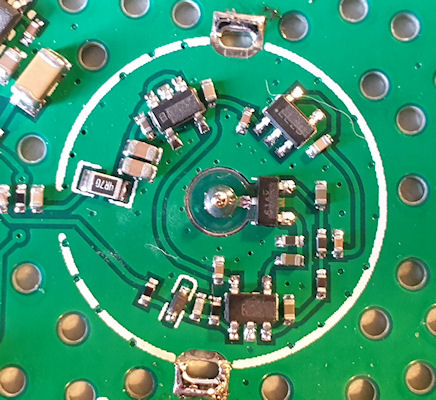
Under the little metal cap on the underside of the chamber there are more discrete electronics and in the center a long gold plated pin that runs into the chamber. All the markings have been removed like the rest of the ICs. It would be very easy to copy this had the part numbers been intact. You could probably make one from a tin of beans, or two. Might not be quite as effective, but I reckon a home made version would be 90% of this bought one.
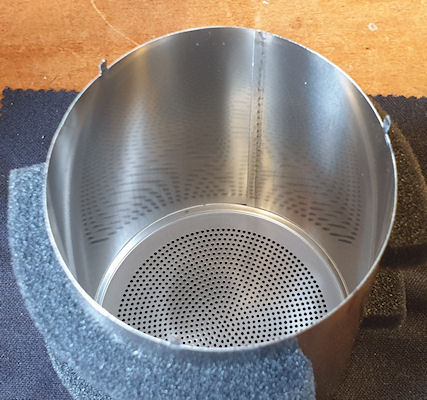 This is the (outer) can of the chamber, and here is where it starts to get interesting.
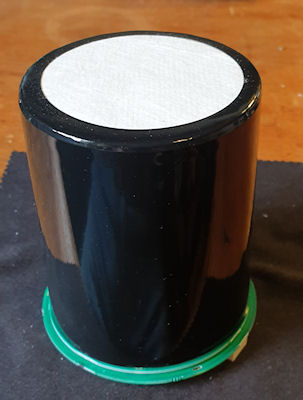 This is the inner can of the chamber. It looks identical to the outer can, but is covered with a plastic insulation and filter membrane at the top. Inside this (inner) can it looks identical to the outer can, but slightly smaller. I didn't measure it.
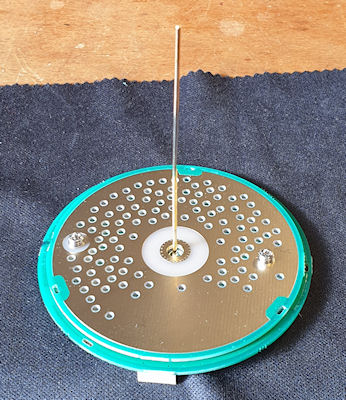 This is the base of the chamber with the long gold plated pin that is connected to the components under the little metal cap on the underside. If you look carefully at the gold plated PCB you can see that one screw is insulated, and the other isn't.
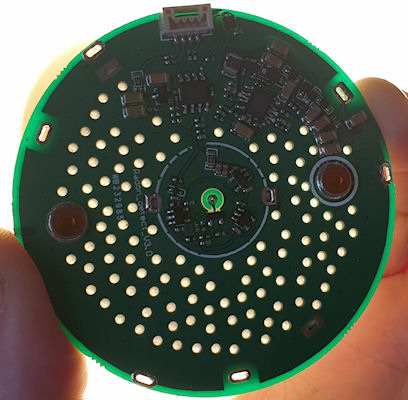 The base is actually two PCBs, sandwiched together with a filter membrane between. The holes in each PCB line up and allow air, or radon to pass through the filter membrane.
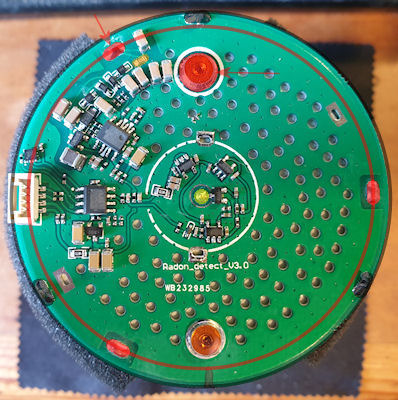 And this is where it all comes together. Firstly, I measured the voltage at 300v. Typical voltage for an ion chamber. But even with the tiny components this thing may be able to reach ~700v. I have a couple of counters with tiny HV PSUs like this, and they are quite capable up to around 700v. It may seem surprising, but you can easily get to a few hundred volts using voltage doublers from ~60v or so. Or even a very simple boost circuit, with a handful of components (switching transistor, inductor, capacitor, diode - literally just those 4 components) and run from a PWM signal can also quite easily get to ~700v. I have a counter right here with a PSU like that and I have pushed it to just under 900v, but it gets squiffy >780v.
Anyway, back to this chamber. If you look at the image above (high resolution images are in the first post), you can see I have marked a black circle and solder pads, a red circle and solder pads, and also one of the screws, and the yellow dot in the center. The yellow dot is the gold plated pin. The black circle is the outer can, and is connected to ground. The red circle is the inner can, and this is connected to +300v, along with the gold plated side of the PCB. The gold plated PCB side is connected to +300v via one of the two screws. The other screw has an insulator on it. By connecting the inner can and the gold plated PCB part to +300v it is more-or-less completely surrounding the gold pin inside, then as the other PCB also has a ground plane on it, this and the outer can pretty much surround the whole inner can. It's a neat design, and seems to work quite well. I don't know what potential the center pin is as as I haven't probed it, but I have a feeling it may be floating - somewhere between +300v and ground. I don't fully understand how this chamber works and the center pin is quite the distance from the inner can. I have a feeling this may require the decay of radon to charge something (the space between the pin and the inner can?) and when it gets to a certain level it ionizes, passes a small current and creates the pulse. Much like a GM tube, but charges from multiple alpha particles (I think) and then completes the circuit, whereas a GM tube is one ionization, one pulse - much faster.
Archived from radmon.org - originally posted 30/06/2025
Add Comment
This policy contains information about your privacy. By posting, you are declaring that you understand this policy:
- Your name, rating, website address, town, country, state and comment will be publicly displayed if entered.
- Aside from the data entered into these form fields, other stored data about your comment will include:
- Your IP address (not displayed)
- The time/date of your submission (displayed)
- Your email address will not be shared. It is collected for only two reasons:
- Administrative purposes, should a need to contact you arise.
- To inform you of new comments, should you subscribe to receive notifications.
- A cookie may be set on your computer. This is used to remember your inputs. It will expire by itself.
This policy is subject to change at any time and without notice.
These terms and conditions contain rules about posting comments. By submitting a comment, you agree with these rules:
- Although the administrator will attempt to moderate comments, not all comments can be moderated at all times.
- You acknowledge that all comments express the opinions of the original author and not those of the administrator.
- You will not post material which is knowingly false, obscene, hateful, threatening, harassing or invasive of privacy.
- The administrator has the right to edit, move or remove any comment for any reason and without notice.
Failure to comply with these rules may result in being banned from submitting further comments.
These terms and conditions are subject to change at any time and without notice.
Comments