
- Posted on
- • Geiger Muller Tubes
Preventing Avalanche Issues with the SBT-10 Geiger Muller Tube
- Author
-
-

- User
- Mr Blinky
- Posts by this author
- Posts by this author
-
A radmon.org user was having avalanche issues with their SBT-10 Geiger Muller tube. Doing a little research I found a little information stating that each anode on the GM tube (there is ten in total) should have it's own quenching resistor. I have mine set with a 10Mohm on each anode (see pic below) and appears to work OK, although I haven't had it running for long and just some simple tests. When I got it I scoured the web looking for info but it seems there is very little. One recurring theme was that the voltage and resistor(s) did play a very big part on getting correct counts from the tube.
From this site: https://sites.google.com/site/diygeigercounter/gm-tubes-supported
SBT10-A - alpha tube A good tube for measuring food? This report from Pedro (thanks for keeping us in the loop): "Finally the replacement for the faulty SBT10-A tube arrived and after connecting it to the Arduino the counter shows a 160/190 CPM with all the segments connected to a 10Mohm resistor. The anode voltage seems to be critical for this tube as it creates avalanches if anode voltage is over 370v. Care must be taken in the voltage calibration as most voltmeters will show erroneous reading due to intrinsic impedance, so in my case the adjustment was made to 330v (digital readout) but the real voltage without voltmeter load was 370v. In my case this tube detects 2400 CPM for a lantern mantle at 10cm from the mica window without alpha blocked and 690 CPM with alpha blocked." [7/22/16] A customer reports that 10MΩ is too low for this tube. He had expected results with as high as 30MΩ. He used that resistance on every anode of the tube. He also said that the sensitivity to the HV setting described above is explained by too low of anode resistance. For the conversion ratio, I calculated using Method 2 below, and got a ratio of 1641 CPM / uSv. Seems high, but is a sensitive tube.
Doing a bit more digging for what little info there is regarding this, I found a forum where a couple of users stated that a 30M ohm resistor works best per anode.
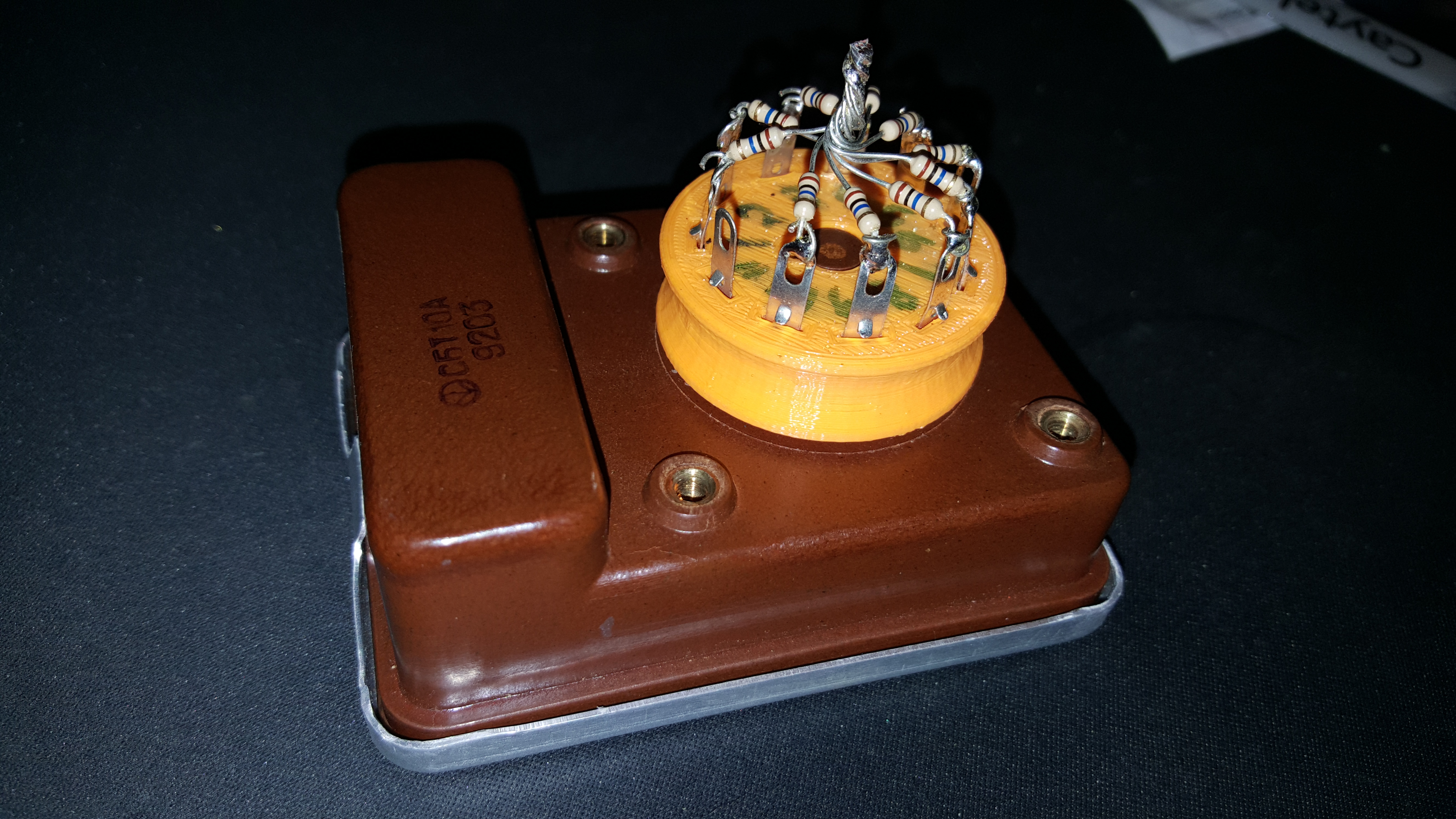 Each anode connection on the 3D printed connector has it's own 10M resistor.
(Paraphrased) Archived from radmon.org - originally posted 19/03/2017
Add Comment
This policy contains information about your privacy. By posting, you are declaring that you understand this policy:
- Your name, rating, website address, town, country, state and comment will be publicly displayed if entered.
- Aside from the data entered into these form fields, other stored data about your comment will include:
- Your IP address (not displayed)
- The time/date of your submission (displayed)
- Your email address will not be shared. It is collected for only two reasons:
- Administrative purposes, should a need to contact you arise.
- To inform you of new comments, should you subscribe to receive notifications.
- A cookie may be set on your computer. This is used to remember your inputs. It will expire by itself.
This policy is subject to change at any time and without notice.
These terms and conditions contain rules about posting comments. By submitting a comment, you agree with these rules:
- Although the administrator will attempt to moderate comments, not all comments can be moderated at all times.
- You acknowledge that all comments express the opinions of the original author and not those of the administrator.
- You will not post material which is knowingly false, obscene, hateful, threatening, harassing or invasive of privacy.
- The administrator has the right to edit, move or remove any comment for any reason and without notice.
Failure to comply with these rules may result in being banned from submitting further comments.
These terms and conditions are subject to change at any time and without notice.
Comments