
- Posted on
- • Geiger Muller Tubes
Black Spots on SBT-10 Geiger Muller Tube
- Author
-
-
- User
- Mr Blinky
- Posts by this author
- Posts by this author
-
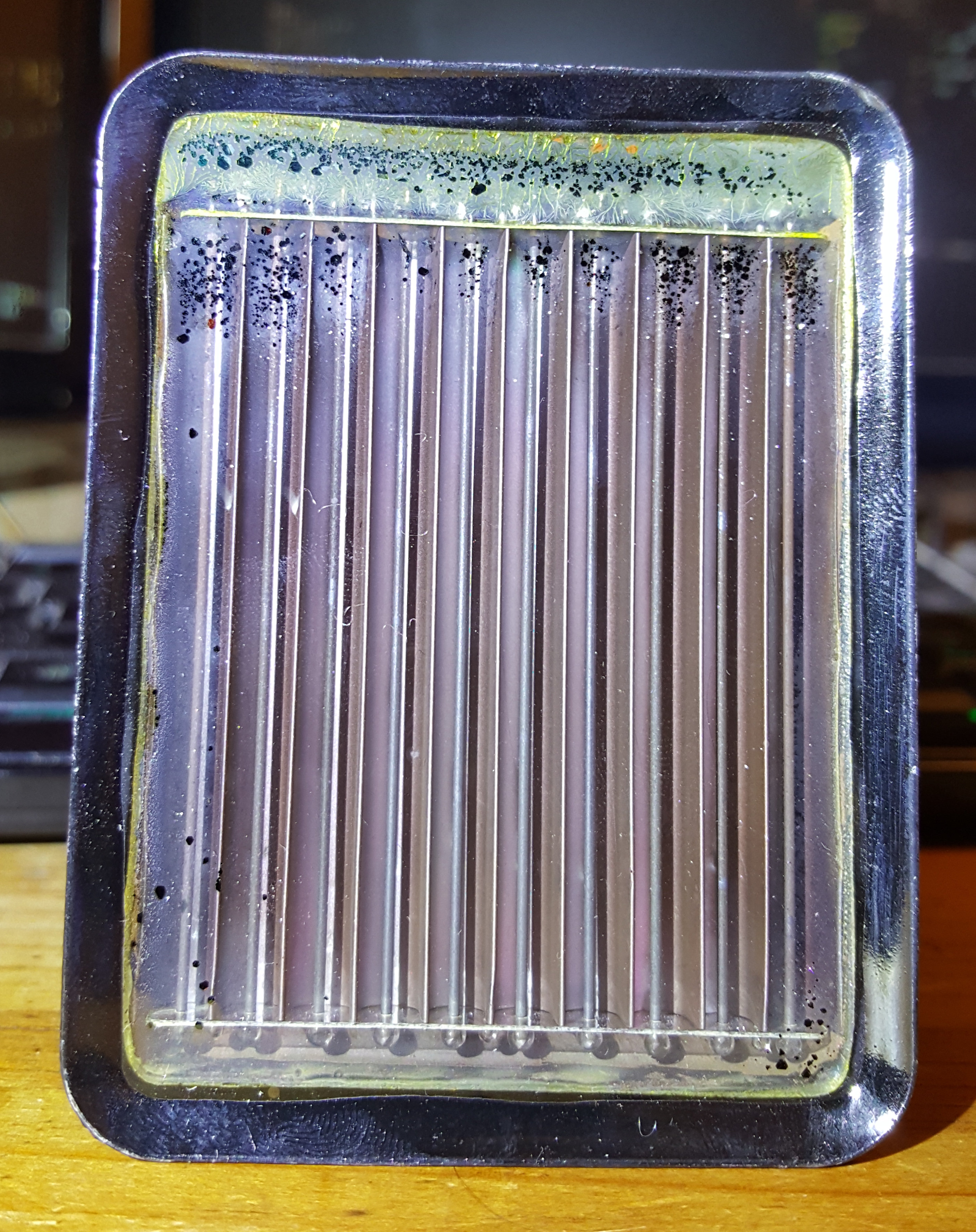
A radmon.org user posted a question asking what the black spots were in his SBT-10. I had recently bought one of these from a seller in Ukraine and mine too has the black spots similar to the one posted on radmon.org. The seller assured me that mine was NOS (new-old-stock), meaning whilst it is old, it has merely been stored for the time and never used. It appears to be working correctly regardless of it's condition. I tested each element separately and each reads around the same CPM as the others so I'm assuming that whilst cosmetically nasty, the black spots appear to do no harm. What causes them I'm unsure of, but I suspect it is some kind of age related issue. Possibly some kind of reaction between the materials and the gasses used in constructing these tubes. I wish I could help you more. I too would like to know what the spots are and if they are impacting the reliability of the tube.
On a side note, I have found a person in Lithuania that supplies a 3D printed connector with pins or just the pins themselves here: http://arduino-geiger-pcb.blogspot.co.uk/2015/03/a-new-contact-socket-for-sbt-10-10.html
After some close inspection I sort of know what the black spots are now. They are some kind of crystalline chemical or mineral that is growing on the surface of the mica.
I put my SBT-10A under my stereo microscope a few weeks ago (before I had a camera for my microscopes) and could see they were hexagonal in shape. Some were like triangles with their points cut off. They appear as arbitrary shapes and almost like little blobs and that is because some grow next to others and some grow on top of others. They appear to be very very thin, although there were a couple that I could just see had a little more length to them. I think they are being caused by some chemical in the resin leaching out and reforming as crystals.
I thought I would follow up with some microscope images of them, but I managed to destroy my tube by accident by dropping a polarizing filter from my microscope onto the tube. File Attachment: So that's the second SBT-10A that has broken on me. File Attachment:
Oh well, at least we can see inside one now! I'll do a separate post on that.
Archived from radmon.org - originally posted 19/03/2017
Add Comment
This policy contains information about your privacy. By posting, you are declaring that you understand this policy:
- Your name, rating, website address, town, country, state and comment will be publicly displayed if entered.
- Aside from the data entered into these form fields, other stored data about your comment will include:
- Your IP address (not displayed)
- The time/date of your submission (displayed)
- Your email address will not be shared. It is collected for only two reasons:
- Administrative purposes, should a need to contact you arise.
- To inform you of new comments, should you subscribe to receive notifications.
- A cookie may be set on your computer. This is used to remember your inputs. It will expire by itself.
This policy is subject to change at any time and without notice.
These terms and conditions contain rules about posting comments. By submitting a comment, you agree with these rules:
- Although the administrator will attempt to moderate comments, not all comments can be moderated at all times.
- You acknowledge that all comments express the opinions of the original author and not those of the administrator.
- You will not post material which is knowingly false, obscene, hateful, threatening, harassing or invasive of privacy.
- The administrator has the right to edit, move or remove any comment for any reason and without notice.
Failure to comply with these rules may result in being banned from submitting further comments.
These terms and conditions are subject to change at any time and without notice.
Comments