
- Posted on
- • Geiger Muller Tubes
SBM-20 and STS-5 (CTC-5) Sensitivity Comparison
- Author
-
-

- User
- Mr Blinky
- Posts by this author
- Posts by this author
-
I wanted to see if there was much difference between the sensitivity between a SBM-20 and STS-5 tubes. For a background test I had an SBM-20 running for a while then swapped it for a STS-5. I think the graph says it all. (Note - there was a discrepancy with the initial background test (below). The test was repeated later and the results are shown towards the end.)
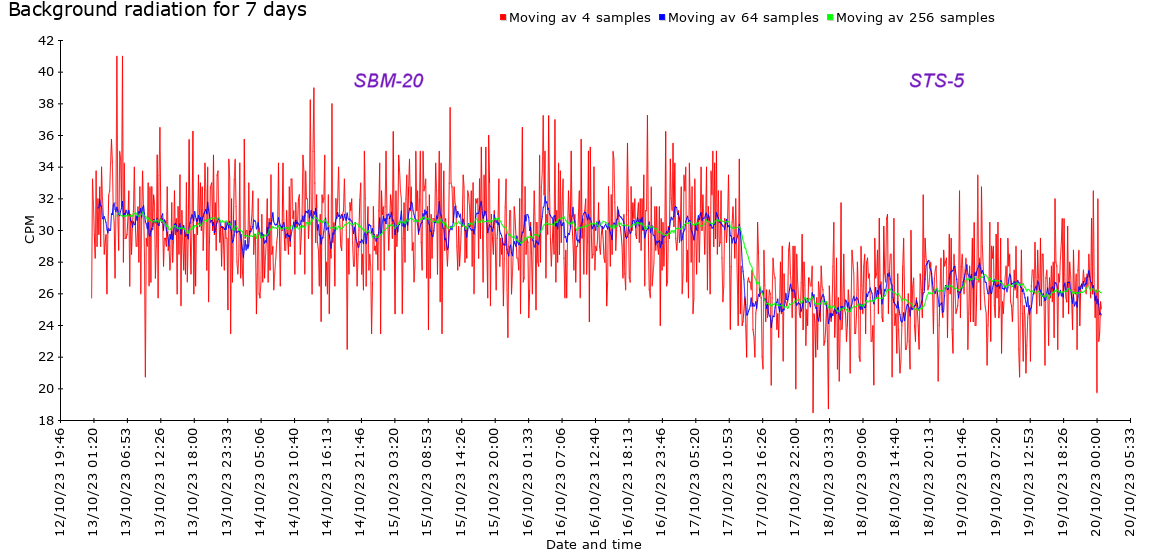
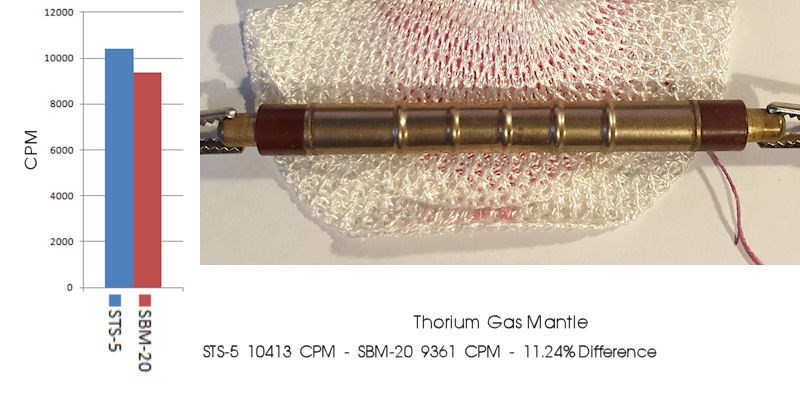
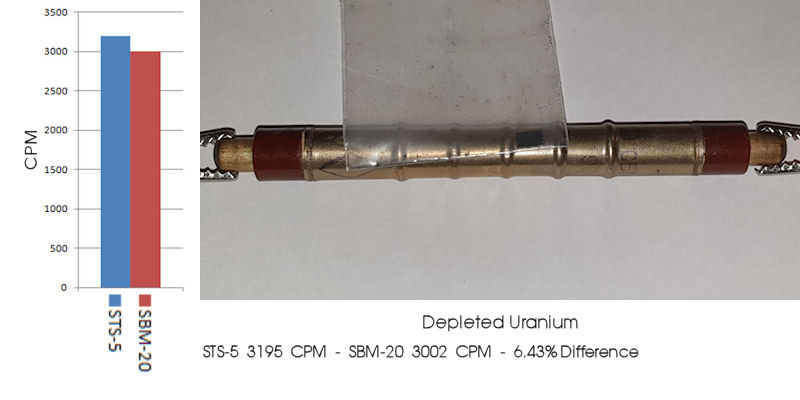
I took this a step further and compared the two tubes using 13 different sources. In hindsight I should have tested a J305 at the same time. It took a surprisingly long time, so I might set up some kind of testing jig and program an ESP to automate a lot of the task. I would also like to do tests at 1cm, 5cm and 10cm, so it would definitely need some kind of automation. I was actually a little surprised to see the STS-5 get a higher CPM for every source, yet the background is less for the STS-5.
Here are the results. There is also a PDF to download if you wish.
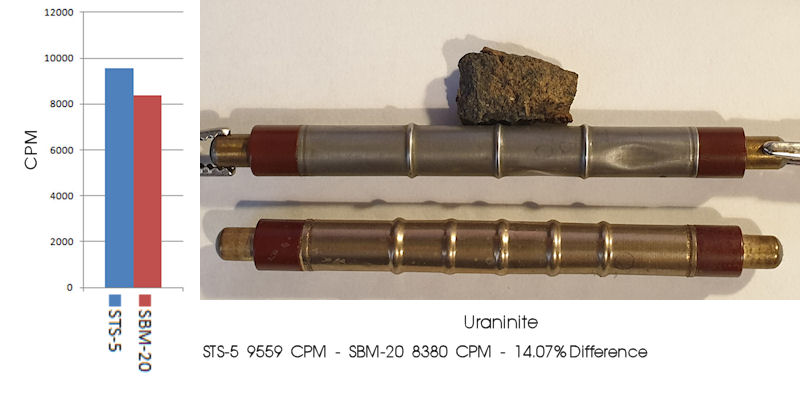
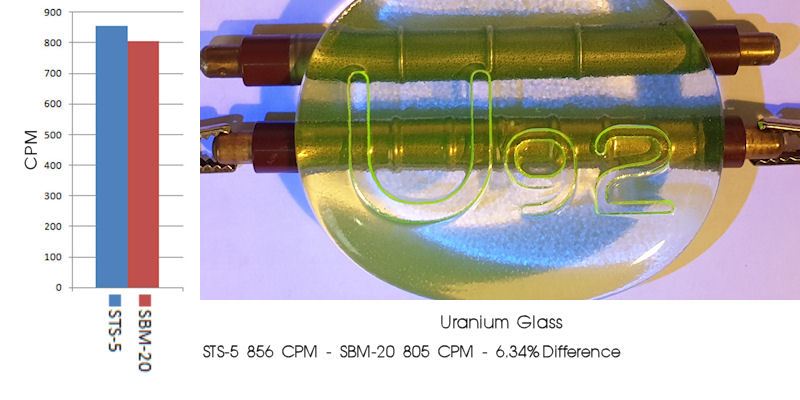
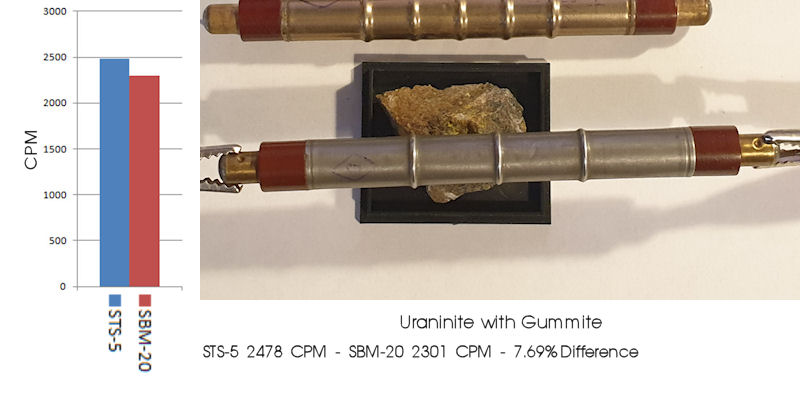
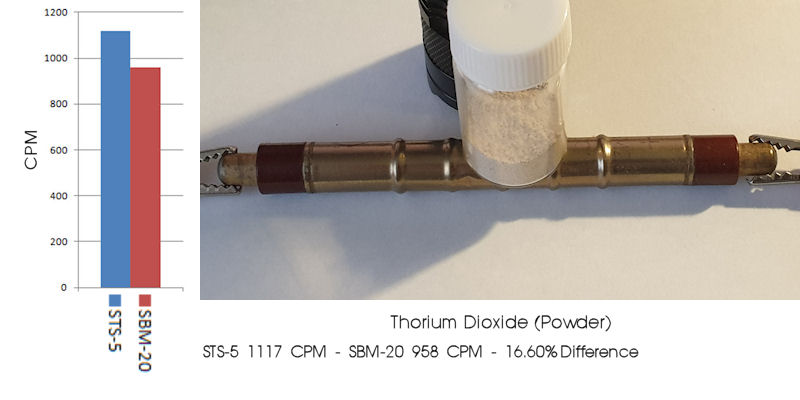
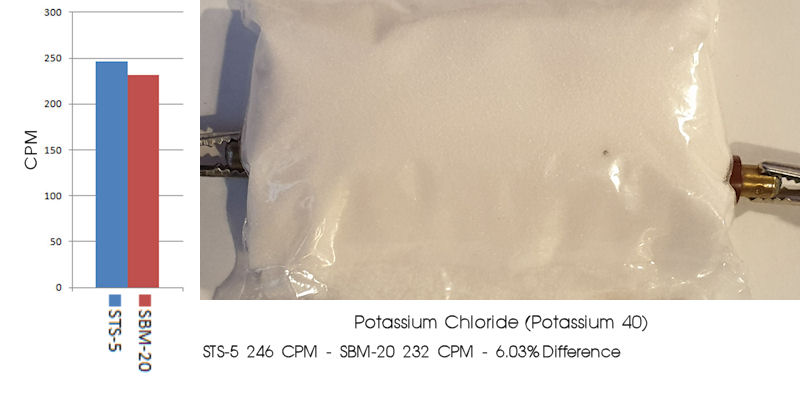
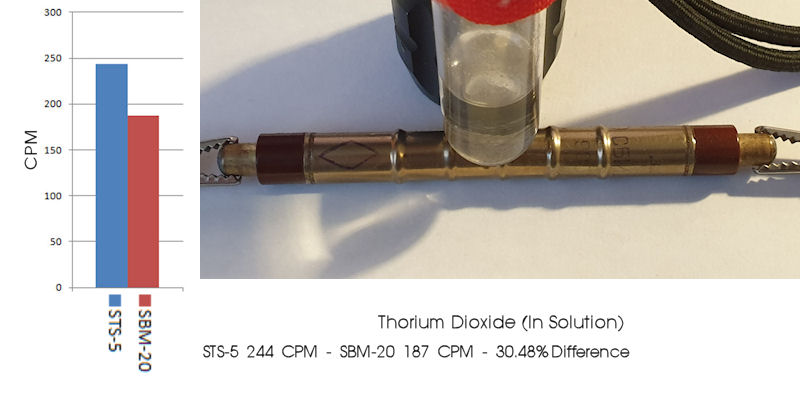
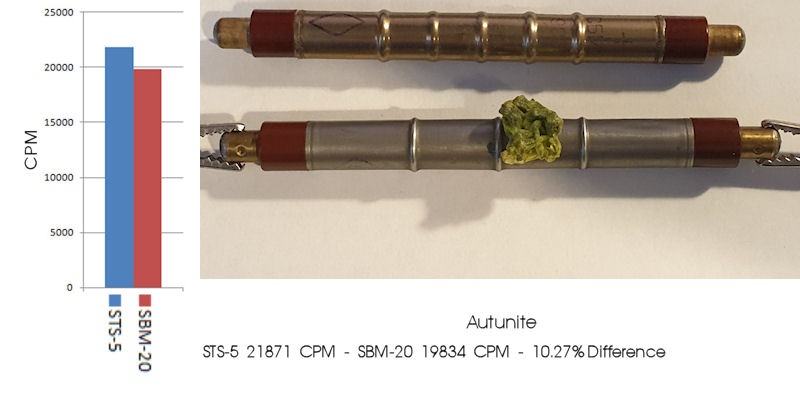
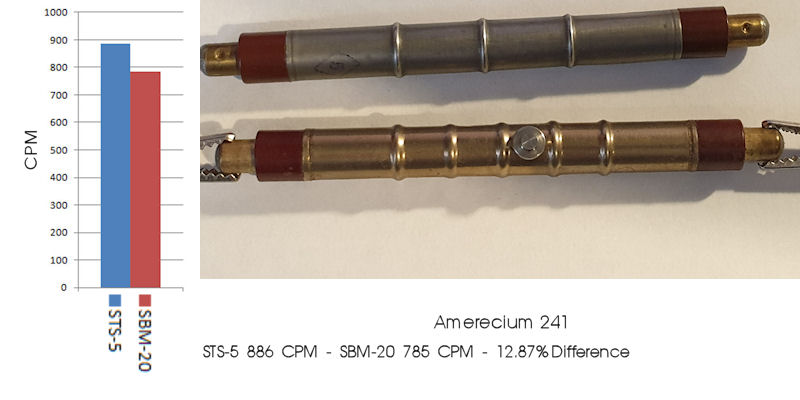
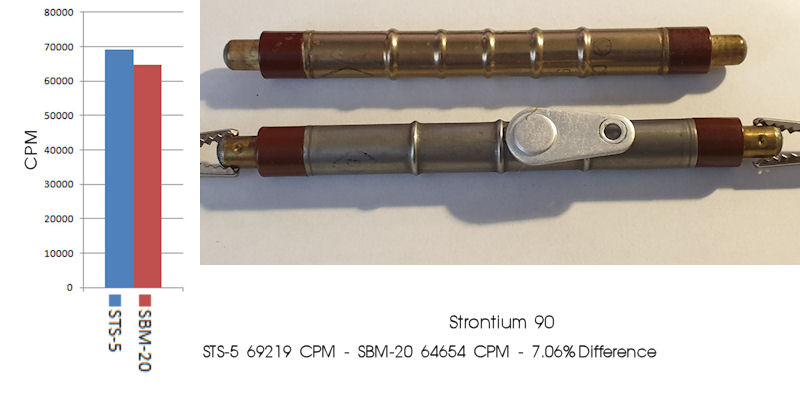
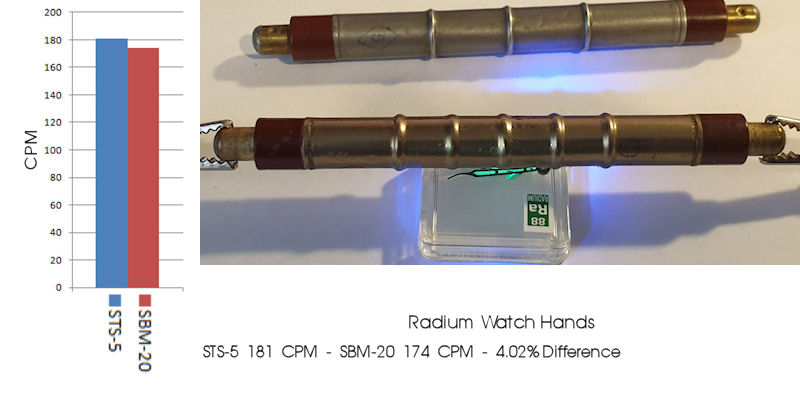
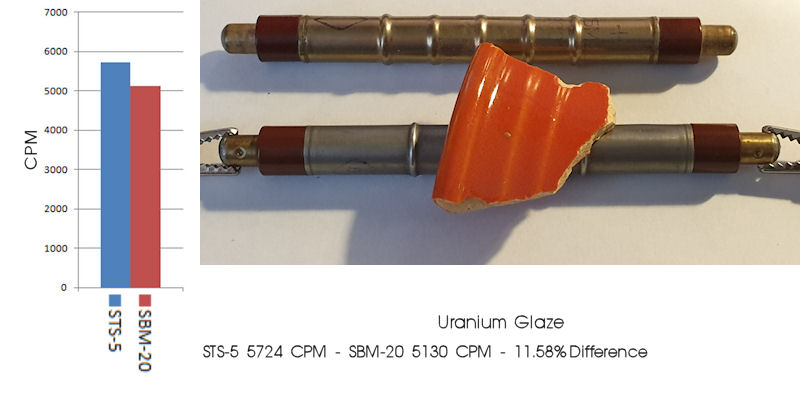
Source                                  STS-5      SBM-20    Difference

    1  Uraninite                        9559        8380     14.07%
    2  Uranium Glass                    856         805       6.34%
    3  Uraninite with Gummite           2478        2301      7.69%
    4  Thorium Dioxide (Powder)         1117        958      16.60%
    5  Potassium Chloride               246         232       6.03%
    6  Thorium Dioxide (In Solution)    244         187      30.48%
    7  Autunite                         21871       19834    10.27%
    8  Amerecium 241                    886         785      12.87%
    9  Strontium 90                     69219       64654     7.06%
    10 Radium Watch Hands               181         174       4.02%
    11 Uranium Glaze                    5724        5130     11.58%
    12 Thorium Gas Mantle               10413       9361     11.24%
    13 Depleted Uranium                 3195        3002      6.43%
I was asked by Juzzie over at radmon.org if I used the same Geiger counter for the background test (1st graph above) and the comparison. The answer is no, they were two different counters. The background was from a GK Radmon, and the source testing was done with my breadboard dev counter, which is effectively a GK v5.5 (older version.) However, I have checked the voltages of both counters and both are correctly set at 390-400v. It wouldn't hurt to repeat the test though using the same counter as the source testing, so I have thrown a SBM-20 on it for a day or so, and then I will swap out to the STS-5 for a day or so. I also think it might be worth repeating the tests I have already done with some averaging - 1 minute, 5 minutes, 15 minutes and maybe 30 minutes. When I was testing the sources with both tubes, the way I decided the CPM was a little fluffy. I let it sit for just over a minute, waited until it peaked and fell, and then used the CPM reading of it's next peak. It might also be worth getting a good background reading for each tube to be tested so that can be subtracted from the resulting CPM to give a more accurate result. I think that might be necessary for doing testing over a distance of 5/10cm.
I am considering actually building some kind of test rig and specific code so semi-automated testing. That way I can just set it up and swap things then push a button and let the Arduino/MCU do it's stuff. I have a few less sensitive tubes (SI3BG/Dextray 3G8B/DOB-50/DOB-80. It would be nice to get some kind of sensitivity data on these too as well as the more common tubes.
I compared the STS-5 and SBM-20 again on the same counter (breadboard dev counter) I used with the sources. Interesting result.... Hardly any difference.
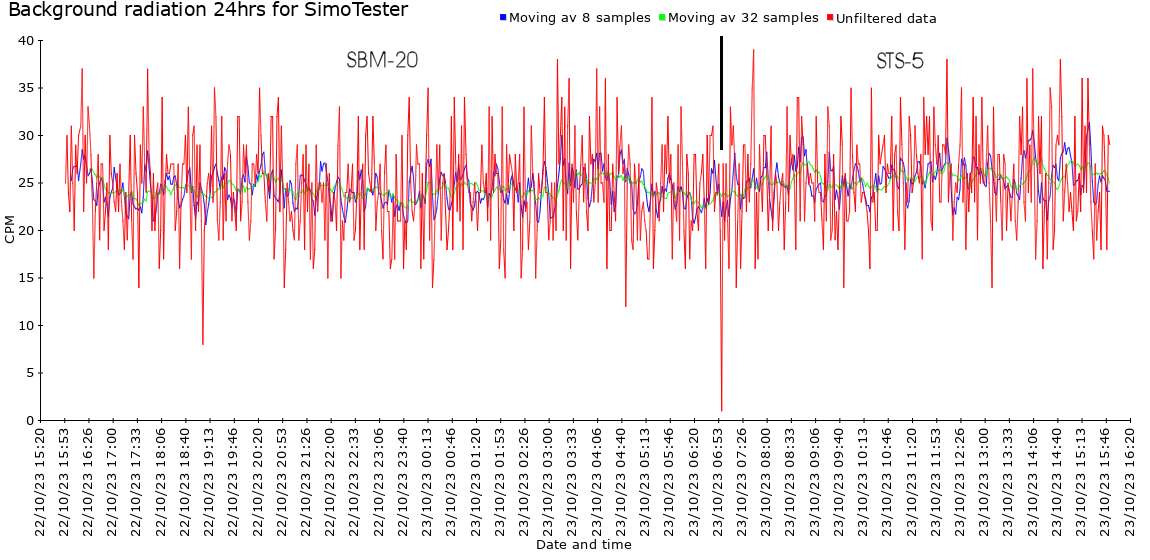
It does beg the question though; why on the first counter (GK Radmon Basic) is there such a difference, yet on the second counter (breadboard GK v5.5) there is hardly any difference. I have doubly checked the voltage on the breadboard counter and its reading 404v right now. Strange. I shall have to have a look at the GK Radmon and see why.....
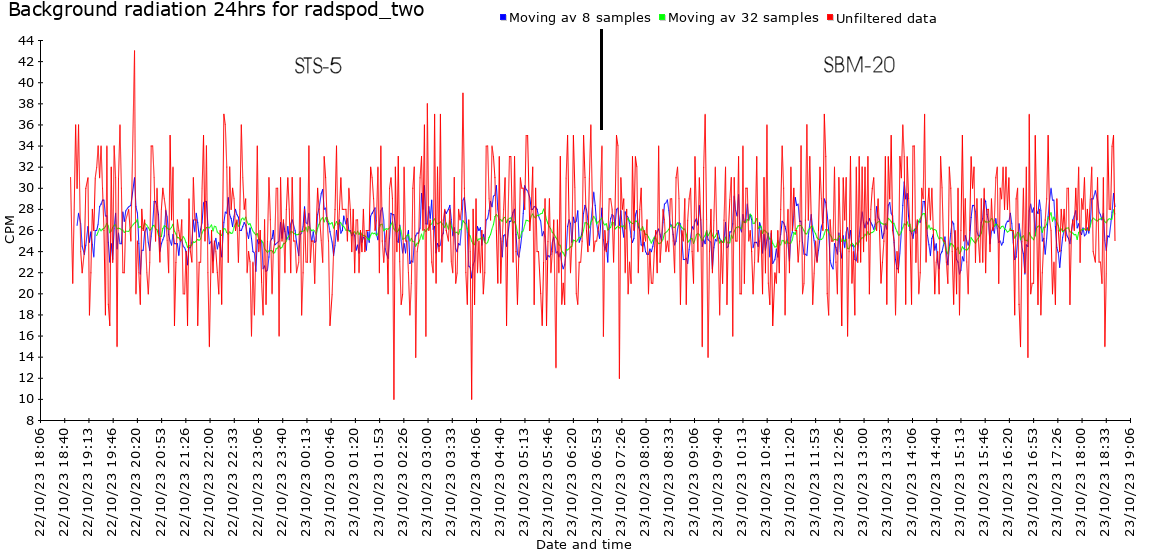
So the GK Radmon now is showing the same background for both tubes. The graph is from radspod_two. I just grabbed this graph, that's why the timing is off the other from SimoTester. It's currently sitting on a shelf in my office and I have been swapping the tubes from that. Radspod_two has SBM-20, breadboard counter has STS-5, then radspod_two has STS-5, breadboard counter gets SBM-20. There was obviously something amiss with the first background reading with both tubes. I know the voltage was high on the GK Radmon, but I can't remember when I changed it back down to 400v. It wasn't when I changed tubes... Or maybe. I dunno. Can't remember. Too many counters around me at the moment. I really do think a purpose built semi-automated system would be a good idea for this. Something that logs every few seconds, checks voltage, or at least logs it and does some decent averaging.
Anyway, the graph from radspod_two, that shows no change in background between tubes, this time....
Archived from radmon.org - originally posted 20/10/2023
Add Comment
This policy contains information about your privacy. By posting, you are declaring that you understand this policy:
- Your name, rating, website address, town, country, state and comment will be publicly displayed if entered.
- Aside from the data entered into these form fields, other stored data about your comment will include:
- Your IP address (not displayed)
- The time/date of your submission (displayed)
- Your email address will not be shared. It is collected for only two reasons:
- Administrative purposes, should a need to contact you arise.
- To inform you of new comments, should you subscribe to receive notifications.
- A cookie may be set on your computer. This is used to remember your inputs. It will expire by itself.
This policy is subject to change at any time and without notice.
These terms and conditions contain rules about posting comments. By submitting a comment, you agree with these rules:
- Although the administrator will attempt to moderate comments, not all comments can be moderated at all times.
- You acknowledge that all comments express the opinions of the original author and not those of the administrator.
- You will not post material which is knowingly false, obscene, hateful, threatening, harassing or invasive of privacy.
- The administrator has the right to edit, move or remove any comment for any reason and without notice.
Failure to comply with these rules may result in being banned from submitting further comments.
These terms and conditions are subject to change at any time and without notice.
Comments