And now hold it at arm's length when using it. Around the time ChatGPT 4.0 came out, it started to become useful to me. Initially I was using it for looking for patterns in Gamma spectra, which it is very good for, when it worked. After a short time of using ChatGPT I found I was hitting limitations due to my free subscription so subscribed to the plus subscription. This lifted the limits and I was full on throwing data at it to analyse, graphing data, put a load of numbers in, get out a visual representation of them. All good stuff. I really quizzed the AI to find out how it works and after
-
-
The Chamber. I wasn't actually going to look into the chamber more, but a radmon.org user was curious, and curiosity got the better of me, so I dug into it - and I'm glad I did! Quite interesting. A little, but not actually quite as I expected. (I have added the high resolution images of this post to the download in the first post of the AEGTest Hound-3699 series.) Under the little metal cap on the underside of the chamber there are more discrete electronics and in the center a long gold plated pin that runs into the chamber. All the markings have been removed like the rest of the ICs. It
-
AEGTest Hound-3699 Radon Monitor Accessing the 'Admin' menu. The manual states: “Admin: Technician access only (Note: Do Not Click.)” Do not click? On something I bought? Something I own? Really? Give me a big red button that says 'do not press,' and I’m going to press it. If it’s locked behind a PIN code, I’m going to try and guess it. And you, AEG Test — you’ve just fuelled me with the absolute determination to click things, crack things, push buttons and tear them to pieces. That said — I still think this is a decent little unit. So everyone deserves access to the admin menu. If you follow
-
AEGTest Hound-3699 Radon Monitor Review & Teardown Many high resolution images of the teardown are here. I have been getting to know Radon quite a bit more of late. I manage a couple of sites at work and these are in Radon areas. I have used the Airthings Corentium and also fitted an Airthings View Radon 2989 in the basement of one of the sites. Monitoring is ongoing. I have also been experimenting with Radon a little too – discovering it’s progeny. I have also discovered that many (all?) of my U-238 sources also emit small amounts of Radon, local to their storage and I want to keep an
-
Here is a 24 day and 10 hour long accumulation from a glow in the dark Tritium tube, vial, thing. It's just like the ones used in fishing indicators, clocks, watches and military defile markers. Often called 'beta lights'. Total counts: 76,669,829 😄 The massive peak at ~11.8 keV is from Zn Kα X-rays emitted as the Tritium hits the zinc sulphide phosphor and the smaller (~85 keV) peak is most likely from X-ray fluorescence from materials near the detector, or could be backscatter from the detector housing. My spectrum is ever so slightly out by 2-3 keV as the peak is shown on the chart at
-
Vintage (circa 1944) Victoreen 6107 / BS 212 GM tubes & HV PSU I picked up these little gems (and they are!) along with a (matching?) power supply, crystal earpiece and instructions on using them to make a rudimentary Geiger counter. I got them for £26.20 shipped, which I think is great price for these pieces of history, although they were sold as parts and unknown if working/no way to test. As it happens, both tubes work great! One tube came wrapped up in vintage fluff in it's original box and the other tube was loose. The loose tube was in worse condition than the boxed one. The boxed
-
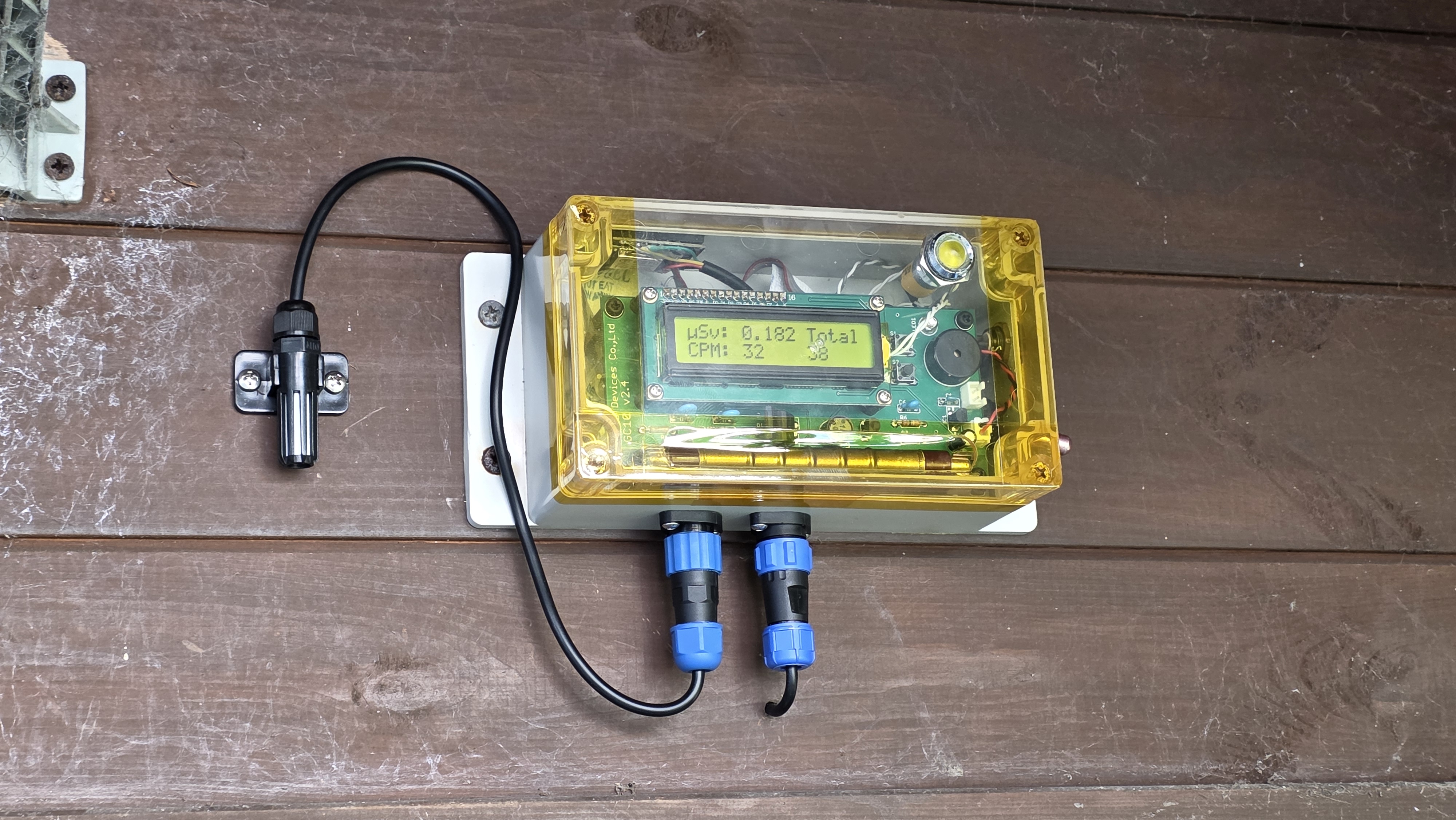
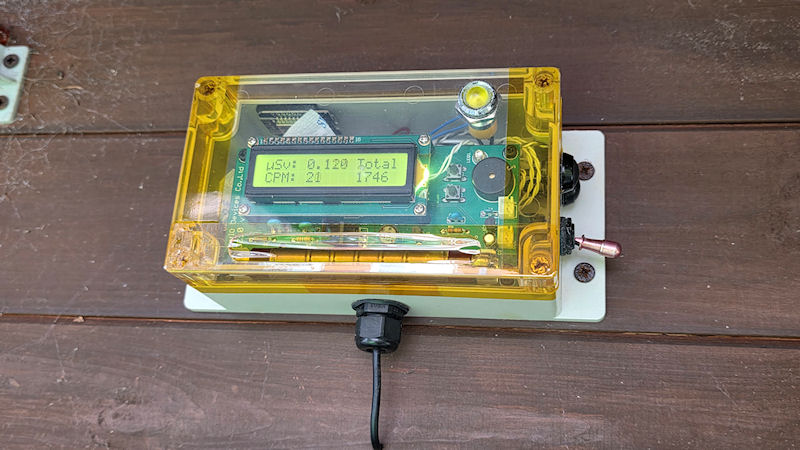
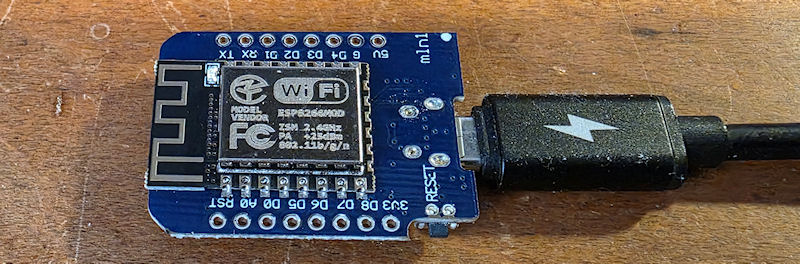
I couldn't wait to tinker with this so I decided to mod this in lieu of getting the ESP-12 modules and programmer. Using a scope I found the connection points I needed, Soldered some wires on. Soldered a Wemos D1 Mini clone on the other end, installed ESPGeiger 0.7.0, and boom! Literally as simple as that. Using the scope I checked the ribbon cable pins one by one and found the pulse coming from the PSU board. I didn't want to solder right on the ribbon, it looks janky already, so probed about and found that it is connected to L12. The MCU side of the inductor is where I soldered the pulse
-
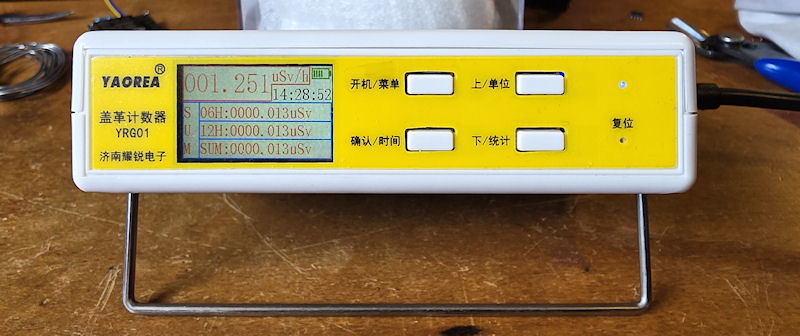
Yaorea YRG01 I bought another cheap Chinese counter from Aliexpress and I am impressed, especially for the price of £27 shipped to my door. Despite its cheap appearance it actually offers a lot of bang for buck. I haven't looked into it closely, but there seems to be a lot of attention to detail, and I reckon whoever designed this really gave a damn about it. 😄 It came up in suggested products on Aliexpress and I wouldn't have bothered about it if not for the fact that someone reviewed it and posted pictures of its insides. "Okay, a glass tube... Ooh a separate PSU board with a big hunking
-
This is a comparison of 8 glass walled GM tubes, with a SBM-20 as a control. I did this some months ago, but hadn't pulled all the data together until now. Of the eight tubes, four are of the J305 flavour - M4011, J305 (2021 - light sensitive), J305 (2023 - not light sensitive) and one that appears to be a copy, with no markings and came in a cheap FS-2011 Geiger counter. The other four are more interesting, or less, depending which way you look at it. The HH614 is from a pen type counter and is quite small and thin. The remaining three are very low sensitivity tubes designed to be used in
-
I got these tubes just to see what they were like. I was a little surprised to learn that they are black due to a sleeve of heat shrink over the tube. I had previously thought they were black due to them being an opaque glass, but after peeling a little of the sleeve off it revealed tin oxide coated clear glass, much like the J305. I accidentally rubbed the markings from the J306 when cleaning it, as I have done on a J305. The markings come off very easy with these tubes. Going from top to bottom - J306, J307 then J308. Specs from Alibaba: Below is the background comparison result. Each tube


.jpg)